Anti-CD38 con bortezomib o lenalidomida en mieloma múltiple inelegible a trasplante: análisis por riesgo citogenético
Rev Hematol Mex. 2026; 2: e19. https://doi.org/10.24245/rev_hematol.v2i1.19
David Garrido,1,2 Johanna Rojas,2 Manuel Granja,3 Sergio Lopresti4
1 Hospital de Especialidades Eugenio Espejo, Quito, Ecuador.
2 Hospital Metropolitano, Quito, Ecuador.
3 Hospital de Especialidades Carlos Andrade Marín, Quito, Ecuador.
4 Hospital Universitario Austral, Buenos Aires, Argentina.
Dear Editor:
Multiple myeloma is a plasma cell malignancy that causes organ injury through bone marrow infiltration and excess monoclonal immunoglobulin. Contemporary guidelines recommend incorporating an antibody targeting CD38 into first-line therapy for most patients.1 However, cytogenetic heterogeneity, particularly deletion 17p and translocations 4;14 and 14;16, may modify the benefit derived from adding an anti-CD38 agent to bortezomib- or lenalidomide-based therapy. This focused pooled analysis of four phase III trials quantifies that effect in transplant-ineligible or transplant-deferred newly diagnosed multiple myeloma.
This was a focused pooled analysis rather than a systematic review. Four phase III randomized trials were identified as pivotal studies evaluating anti-CD38-containing regimens in transplant-ineligible or transplant-deferred newly diagnosed multiple myeloma: ALCYONE, MAIA, CEPHEUS, and IMROZ. During revision, a focused search of PubMed/MEDLINE and publisher websites was performed up to September 2026 using the terms “newly diagnosed multiple myeloma,” “transplant-ineligible,” “transplant-deferred,” “anti-CD38,” “daratumumab,” “isatuximab,” “ALCYONE,” “MAIA,” “CEPHEUS,” and “IMROZ.” Full manuscripts and supplementary materials were reviewed. Trials were eligible if they randomized untreated adults judged ineligible or deferred for autologous transplantation and compared an anti-CD38 regimen with the identical backbone without the antibody. 2-5
For consistency across studies, the analysis was based on the first peer-reviewed full publication of each trial that reported progression-free survival estimates according to cytogenetic risk. Later updates were not included in the primary analysis, but this choice is acknowledged as a limitation, particularly for trials with subsequent longer follow-up.
Hazard ratios and their 95% confidence intervals were extracted directly from the original publications and supplementary materials. Log-hazard ratios and standard errors were calculated using the formula SE = [ln(U)−ln(L)]/3.92. Given the differences among the included trials in treatment backbone, anti-CD38 antibody, eligibility criteria, and duration of follow-up, the primary analysis used inverse-variance pooling of log-hazard ratios under a DerSimonian-Laird random-effects model. Conventional 95% confidence intervals were reported as the primary estimates. Because between-study variance was negligible, random-effects estimates were very close to common-effect estimates. Hartung-Knapp estimates were assessed as sensitivity analyses and were not used as the primary estimates. Heterogeneity was evaluated using Cochran’s Q, τ², and Higgins’ I². Table 1
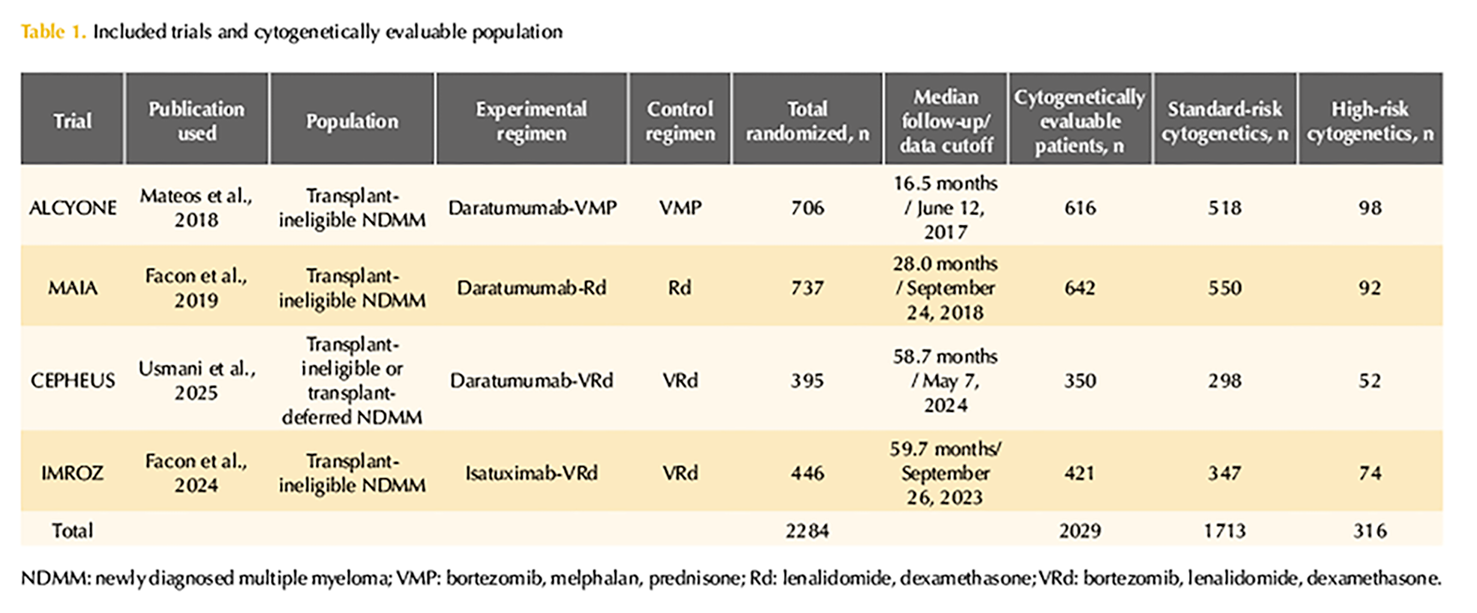
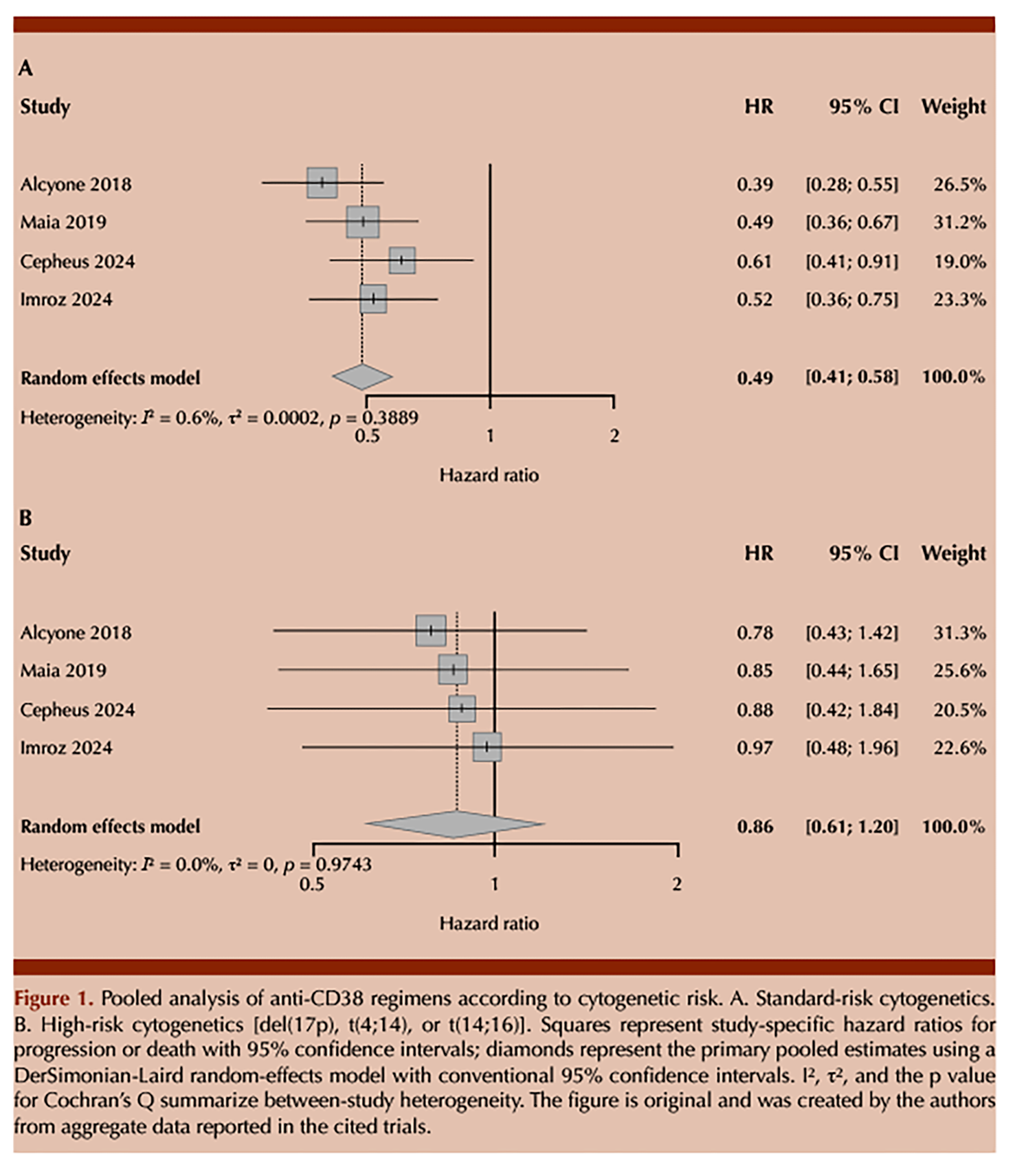
The combined data set included 2,029 cytogenetically evaluable patients, of whom 316 (15.6%) had high-risk cytogenetics and 1,713 (84.4%) had standard-risk cytogenetics. In the high-risk subgroup, the study-specific hazard ratios for progression or death were 0.78 for ALCYONE, 0.85 for MAIA, 0.88 for CEPHEUS, and 0.97 for IMROZ. The primary pooled estimate was 0.86 (95% CI 0.61-1.20), with negligible between-study heterogeneity (Q = 0.22; τ² = 0; I² = 0%).
In the standard-risk subgroup, the study-specific hazard ratios for progression or death were 0.39, 0.49, 0.61, and 0.52 for ALCYONE, MAIA, CEPHEUS, and IMROZ, respectively. The primary pooled estimate was 0.49 (95% CI 0.41–0.58), also with negligible between-study heterogeneity (τ² ≈ 0; I² < 1%). This estimate corresponds to an approximate 51% reduction in the risk of progression or death among patients with standard-risk cytogenetics. In contrast, the estimate in patients with high-risk cytogenetics was less precise, mainly because of the smaller sample size. Therefore, the apparent difference between cytogenetic risk groups should be interpreted as exploratory and not as evidence of a confirmed interaction. Figure 1
More mature follow-up has become available for some of the included trials. The final analysis of ALCYONE confirmed a sustained overall survival benefit for daratumumab-VMP after a median follow-up of 86.7 months, and the final survival analysis of MAIA reported improved overall survival with daratumumab-Rd after a median follow-up of 89.3 months. More recent reports have also provided additional information on age, frailty, and MRD dynamics in CEPHEUS and IMROZ. However, these updates were not incorporated into the primary pooled analysis because they did not uniformly provide directly comparable progression-free survival hazard ratios according to the same cytogenetic-risk strata across all four trials. Therefore, the present analysis should be interpreted as a focused synthesis based on the publications that reported comparable PFS estimates by cytogenetic risk.6-9
Taken together, this focused pooled analysis suggests that anti-CD38 antibodies are associated with a clear progression-free survival benefit in patients with standard-risk cytogenetics. In patients with high-risk cytogenetics, the pooled estimate also favored anti-CD38 therapy, but the confidence interval was wider and included the null value, mainly because of the smaller number of patients. Therefore, this analysis cannot establish whether the magnitude of benefit truly differs between cytogenetic risk groups. Further trials specifically designed for high-risk, older, and frail patients are needed, particularly studies evaluating combinations with next-generation proteasome inhibitors or modern immunomodulatory drugs while carefully considering treatment-related toxicity.
STATEMENTS
Conflicts of interest
The authors declare no conflicts of interest related to this work.
Funding
This research received no external funding.
Ethics approval and informed consent
Not applicable. This study was based exclusively on aggregate data from previously published clinical trials and did not involve new recruitment, access to individual patient data, or interventions in humans or animals by the authors.
Use of artificial intelligence
The authors used ChatGPT (OpenAI) to support language editing and adaptation of the manuscript to journal format. The authors verified all content, references, and statistical results and take full responsibility for the final manuscript.
REFERENCES
1. Rajkumar SV. Multiple myeloma: 2024 update on diagnosis, risk-stratification, and management. Am J Hematol 2024; 99: 1802-1824. https://doi.org/10.1002/ajh.27422
2. Facon T, Kumar S, Plesner T, et al. Daratumumab plus lenalidomide and dexamethasone for untreated myeloma. N Engl J Med 2019; 380: 2104-2115. https://doi.org/10.1056/NEJMoa1817249
3. Mateos MV, Dimopoulos MA, Cavo M, et al. Daratumumab plus bortezomib, melphalan, and prednisone for untreated myeloma. N Engl J Med 2018; 378: 518-528. https://doi.org/10.1056/NEJMoa1714678
4. Facon T, Dimopoulos MA, Leleu XP, et al. Isatuximab, bortezomib, lenalidomide, and dexamethasone for multiple myeloma. N Engl J Med 2024; 391: 1597-1609. https://doi.org/10.1056/NEJMoa2400712
5. Usmani SZ, Facon T, Hungria V, et al. Daratumumab plus bortezomib, lenalidomide and dexamethasone for transplant-ineligible or transplant-deferred newly diagnosed multiple myeloma: the randomized phase 3 CEPHEUS trial. Nat Med 2025; 31: 1195-1202. https://doi.org/10.1038/s41591-024-03485-7
6. Mateos MV, San-Miguel J, Cavo M, et al. Bortezomib, melphalan, and prednisone with or without daratumumab in transplant-ineligible patients with newly diagnosed multiple myeloma (ALCYONE): final analysis of an open-label, randomised, multicentre, phase 3 trial. Lancet Oncol 2025; 26 (5): 596-608. https:://doi.org/10.1016/S1470-2045(25)00018-X
7. Facon T, Kumar SK, Orlowski RZ, et al. Daratumumab, lenalidomide, and dexamethasone in transplant-ineligible newly diagnosed multiple myeloma: MAIA final survival analysis. Leukemia 2026. https://doi.org/10.1038/s41375-026-03097-9
8. Venner C, Zweegman S, Kumar S, et al. Age and frailty analyses of transplant-ineligible patients with newly diagnosed multiple myeloma in the phase 3 MAIA and CEPHEUS trials of daratumumab plus lenalidomide-dexamethasone and bortezomib-lenalidomide-dexamethasone. J Clin Oncol 2026; 44 (16 Suppl): 7569. https://doi.org/10.1200/JCO.2026.44.16_suppl.7569
9. Orlowski RZ, Dimopoulos MA, Leleu X, et al. Isatuximab, bortezomib, lenalidomide, and dexamethasone for multiple myeloma: dynamics of MRD negativity in the IMROZ study. Blood 2026; 147 (23): 2760-2769. https://doi.org/10.1182/blood.2025030120
Received: July 23, 2026
Accepted: September 11, 2026
Este artículo debe citarse como: Garrido D, Rojas J, Granja M, Lopresti S. Anti-CD38 plus bortezomib or lenalidomide in transplant-ineligible newly diagnosed myeloma: Pooled analysis by cytogenetic risk. Hematol Méx 2026; 2: e19.